Your cart is empty
Your cart is currently empty. Let us assist you in finding the right product.

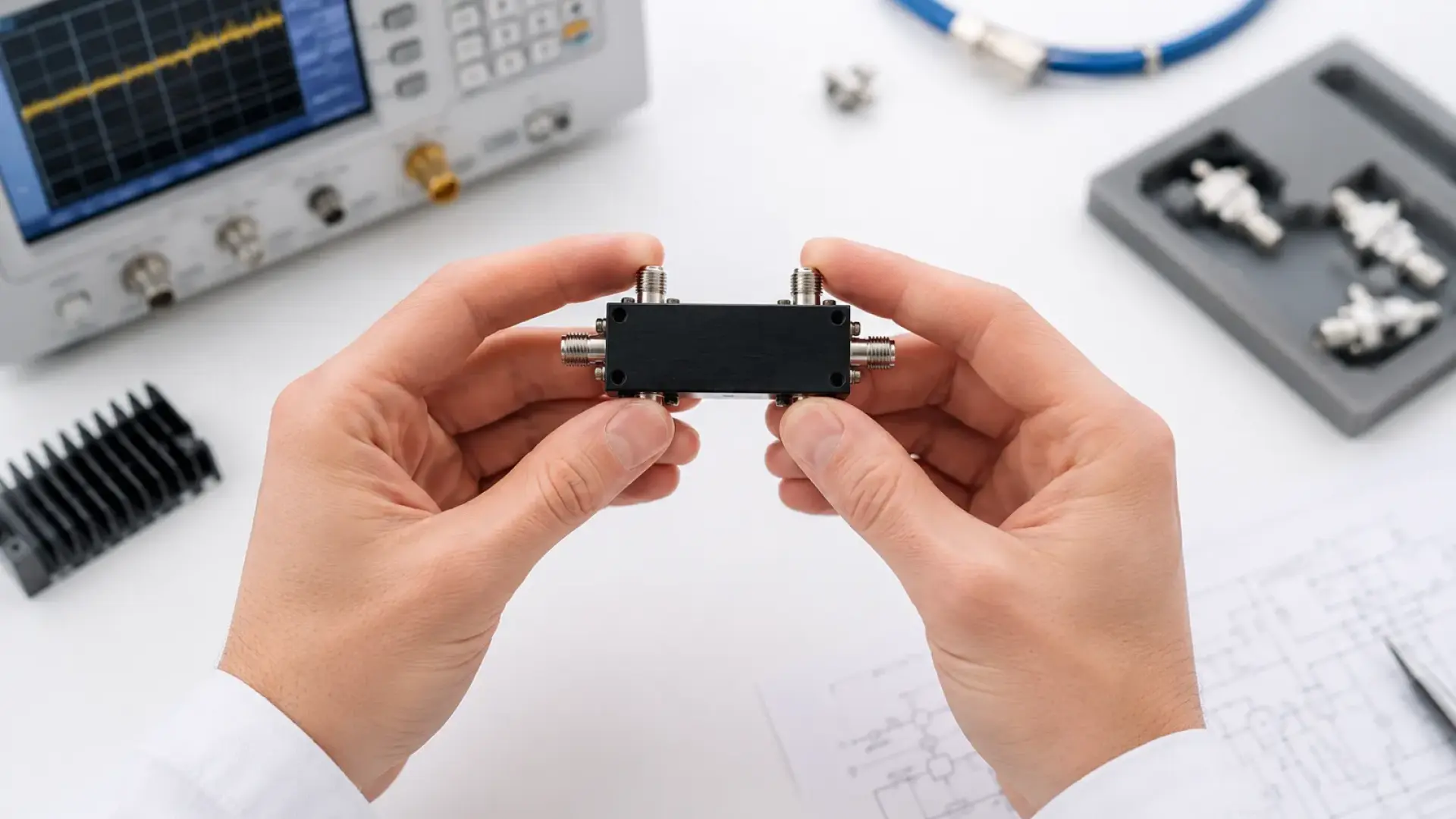
Directional couplers rarely get the spotlight — they're not the amplifier, not the antenna, not the headline component. But in test setups, monitoring systems, and signal distribution networks, a poorly chosen coupler quietly undermines everything downstream of it. Here's a practical look at how they work and what to check before you spec one.
The Basic Job of a Coupler
A directional coupler samples a small, known fraction of power flowing through a transmission line — without meaningfully disturbing the main signal — and routes it to a separate port for measurement or monitoring. That's it in principle. In practice, the quality of that sample depends entirely on how well the coupler isolates direction, minimizes loss, and holds its coupling value across your frequency range.
Coupling Value: Pick Based on Signal Level, Not Convention
A common mistake is defaulting to a "standard" coupling value (10 dB, 20 dB, 30 dB) without checking whether it actually matches your monitoring equipment's dynamic range. Too tight a coupling value can starve your measurement port of signal; too loose can overload it. Always work backward from what your detector or analyzer needs to see.
Directivity Is the Spec That Actually Separates Good From Great
Insertion loss and coupling value are easy to compare across datasheets. Directivity is where real performance differences show up — it determines how well the coupler distinguishes forward power from reflected power. Low directivity introduces measurement error that's easy to miss until your test data doesn't match your expected results. For applications like VSWR monitoring or power amplifier protection, directivity should be one of the first specs you scrutinize, not the last.
Frequency Range and Flatness Across the Band
A coupler that holds tight coupling flatness across a wide band (DC to 67 GHz coverage, for example) gives you consistent, predictable behavior as your system evolves or as you reuse the same design across multiple frequency bands. Wide, flat performance also reduces the calibration burden on your test and measurement setup.
Where Precision Couplers Matter Most
Telecom infrastructure: monitoring signal distribution across dense network equipment without introducing loss that degrades overall link performance.
Aerospace and defense: power monitoring and VSWR protection in systems where a failure isn't just inconvenient — it's mission-critical.
Test and measurement: any setup where measurement accuracy depends on the coupler being a "clean window" into the main signal path, not a source of error itself.
The Takeaway
Directional couplers look simple on paper, but directivity, coupling accuracy, and flatness across your operating band are what separate a component that quietly does its job from one that introduces subtle, hard-to-diagnose errors into your system.

Buy ₹100 more to get free shipping
Your cart is currently empty. Let us assist you in finding the right product.